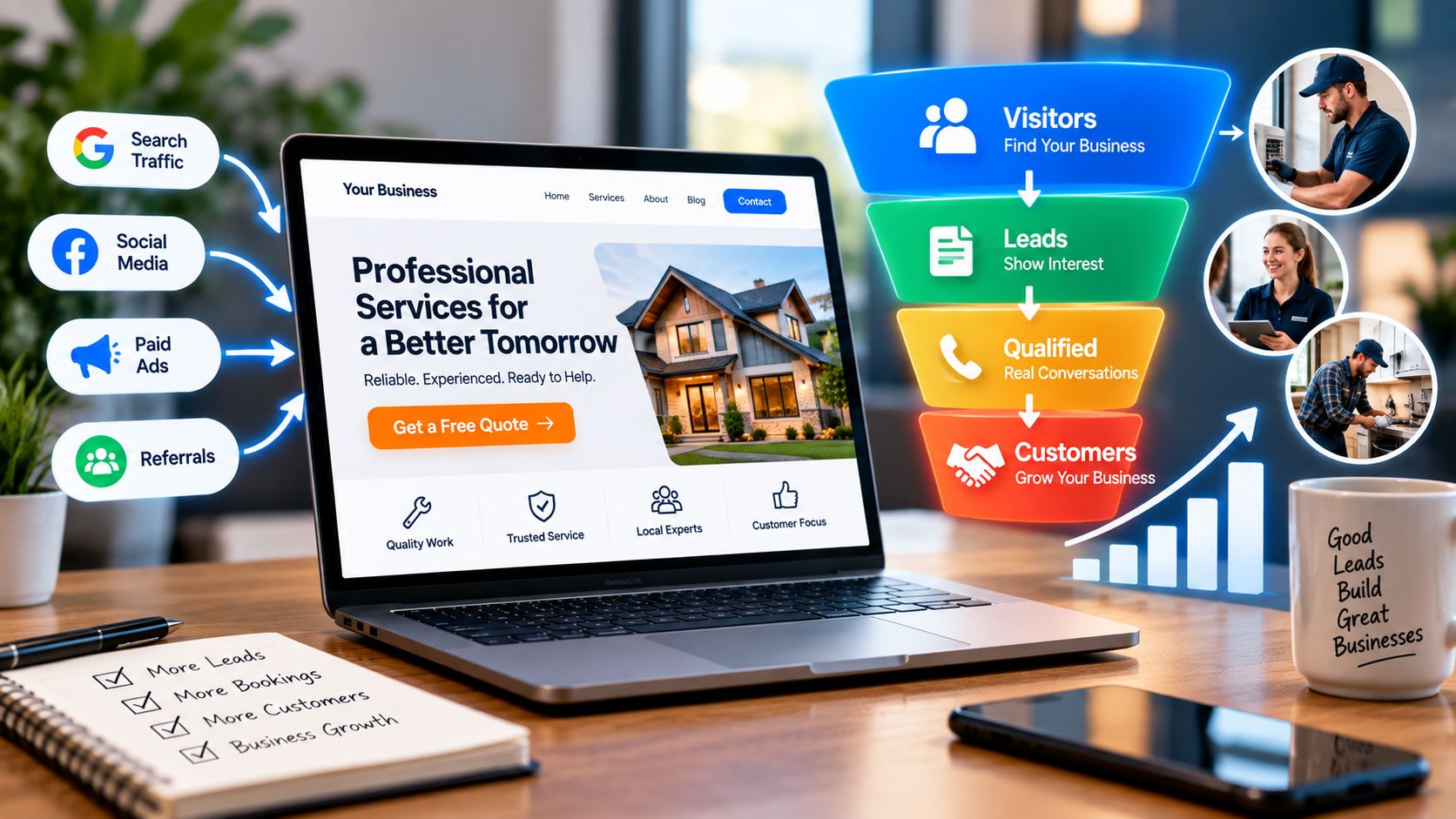
A service business can do excellent work and still have an unpredictable sales pipeline. Some weeks bring a steady flow of inquiries, while others leave the team wondering where the next customer will come from.
The problem is often not a lack of possible customers. It is the absence of a connected process for attracting the right audience, capturing interest, qualifying inquiries, and following up consistently.
Lead generation works best when it is treated as a system rather than a collection of isolated marketing activities. For service businesses, that system needs to reflect how customers actually make decisions, from the first search or recommendation through the initial conversation and eventual purchase.
Start by Defining the Right Customer
Before choosing advertising channels or creating more content, a business should have a clear understanding of who it wants to attract.
A good customer profile goes beyond basic demographics. Consider the services they need, the problems they are trying to solve, where they are located, how urgently they need help, and what usually influences their decision.
For example, a commercial cleaning company may want recurring contracts rather than one-time jobs. A remodeling contractor may focus on homeowners planning larger projects. An IT service provider may be more interested in businesses that need ongoing support.
These differences affect almost every part of lead generation.
Companies exploring outside support for customer acquisition can also review providers such as Client Drive while considering what type of lead generation process makes sense for their particular market.
Build a Clear Path From Attention to Inquiry
Getting someone to notice a business is only the beginning.
A potential customer needs a clear path from discovering the company to expressing interest.
That path might begin with an online search, social media post, advertisement, referral, or educational article. From there, the visitor should be able to find useful information and understand what action to take next.
A service website should make basic questions easy to answer:
What does the company offer?
Who does it serve?
Where does it operate?
How can someone request information or start a conversation?
A clear path reduces unnecessary friction and gives interested visitors a reason to continue.
Use Different Content for Different Stages
Not everyone who encounters a business is ready to buy immediately.
Someone who has just discovered a problem may still be researching possible solutions. Another visitor may already understand the problem and be comparing providers. A third may be ready to request a quote.
The content offered to these visitors can reflect those differences.
Educational articles, guides, checklists, and videos can help people in the research stage. Service pages, comparisons, testimonials, and detailed explanations can support people evaluating their options. Contact forms, consultations, estimates, or booking options can serve visitors who are ready to act.
HubSpot’s lead generation funnel guide similarly describes lead generation as a process that moves from attracting visitors to capturing, qualifying, nurturing, and eventually converting prospects.
Thinking about lead generation in stages makes it easier to create the right message for the right prospect.
Make the Offer Worth Responding To
A potential customer needs a reason to provide their contact information or start a conversation.
For some service businesses, that reason is straightforward: an estimate, consultation, appointment, assessment, or quote.
For others, a lower-commitment offer may work better. A useful checklist, guide, planning resource, or educational consultation can give someone a reason to take the first step without immediately committing to a purchase.
The offer should be closely related to the service.
A financial advisor might provide a retirement planning guide. A home improvement company could offer a project planning checklist. An IT provider might provide a basic technology assessment.
The more closely the offer matches the customer’s actual problem, the more useful the resulting inquiries are likely to be.
Make Qualification Part of the Process
Not every inquiry is equally valuable.
A lead might be outside the service area, looking for a service the company does not provide, or simply gathering information for a project that is still far away.
That does not necessarily make the inquiry worthless, but it does mean the business needs a way to prioritize opportunities.
Simple qualification questions can help.
Depending on the industry, these might cover location, service required, project timeframe, company size, budget range, or the nature of the problem.
The goal should not be to make the contact process unnecessarily difficult. Instead, the business should collect enough information to understand whether the opportunity is a reasonable fit.
Respond Consistently After a Lead Arrives
Lead generation and lead management are closely connected.
A business can attract suitable prospects and still lose opportunities if inquiries are not handled properly.
Every incoming lead should have a clear next step. Someone should be responsible for reviewing the inquiry, responding, recording relevant information, and determining what happens afterward.
For smaller businesses, this may be a straightforward manual process. Larger teams may use CRM systems, automated notifications, lead routing, and follow-up sequences.
The technology can vary, but the underlying principle remains the same: a promising inquiry should not disappear because nobody knew who was supposed to handle it.
Use Follow-Up to Develop Longer-Term Opportunities
Some service purchases happen quickly. Others take weeks or months.
A business dealing with emergency repairs may have a short decision cycle. A company selling renovation, consulting, professional services, or larger commercial projects may need to maintain communication for much longer.
Follow-up gives businesses an opportunity to remain useful during that period.
Instead of repeatedly sending sales messages, companies can provide relevant information, answer questions, share useful resources, or check whether the customer’s circumstances have changed.
This is particularly important for leads that are interested but not yet ready to purchase.
A structured follow-up process also gives sales teams a better understanding of where each prospect stands.
Connect Marketing Activity With Business Results
Lead counts alone do not tell the complete story.
Suppose one channel produces many inquiries but few customers, while another generates fewer inquiries and a higher percentage of suitable opportunities.
The second channel may deserve more attention even though its initial numbers look smaller.
Businesses should therefore track the stages that matter to them.
These may include:
- Number of inquiries
- Qualified opportunities
- Appointments or consultations
- Estimates or proposals
- Closed sales
- Revenue by source
This makes it possible to identify where the pipeline is working and where prospects are dropping out.
It also helps prevent marketing decisions from being based solely on traffic, impressions, or form submissions.
Consider Outside Lead Generation Support
Building a reliable lead generation system internally can require time, marketing knowledge, technology, and ongoing testing.
For some service businesses, working with an external provider can be one way to supplement internal efforts.
The important consideration is whether the approach fits the company’s actual sales process.
Before choosing an outside partner, businesses should understand what type of prospects they need, how inquiries will be delivered, how leads will be qualified, and who will be responsible for following up.
For businesses researching additional lead generation support for service businesses, the same questions should apply: Does the approach fit the target customer, service area, sales process, and capacity of the business?
The goal is not simply to add more names to a database. It is to create opportunities that the business can realistically serve and develop.
Review the Pipeline Regularly
A lead generation system should not be considered finished once it is launched.
Customer behavior changes. Some services become more popular, new competitors enter the market, advertising costs change, and businesses themselves may expand into new markets or services.
Regular reviews can reveal where adjustments are needed.
If a campaign generates too many unsuitable inquiries, targeting may need to change. If website visitors rarely contact the company, the offer or conversion path may need improvement. If qualified leads are being lost after the initial inquiry, the follow-up process may be the issue.
Looking at the complete customer journey makes these problems easier to identify.
Build a System That Sales Can Actually Use
Reliable lead generation is ultimately about creating a repeatable process.
The business needs to know who it wants to attract, where those prospects can be reached, what information will encourage them to make contact, how inquiries will be qualified, and what happens after the first interaction.
When marketing and sales work from the same process, each lead becomes easier to understand and manage.
The result is not necessarily a larger pipeline at every moment. It is a pipeline the business can measure, improve, and support with the resources it actually has.
For service businesses, that distinction matters. Sustainable growth comes from consistently creating relevant opportunities and having a practical process for turning those opportunities into customer relationships.